Erasmus+ 2027: what is new for Latin America and the Caribbean in the last call of the cycle
The 2027 work programme closes the 2021-2027 Erasmus+ cycle. Less money for Capacity Building, two new European partners, and a clearer link to Global Gateway. What it means for universities in the region.
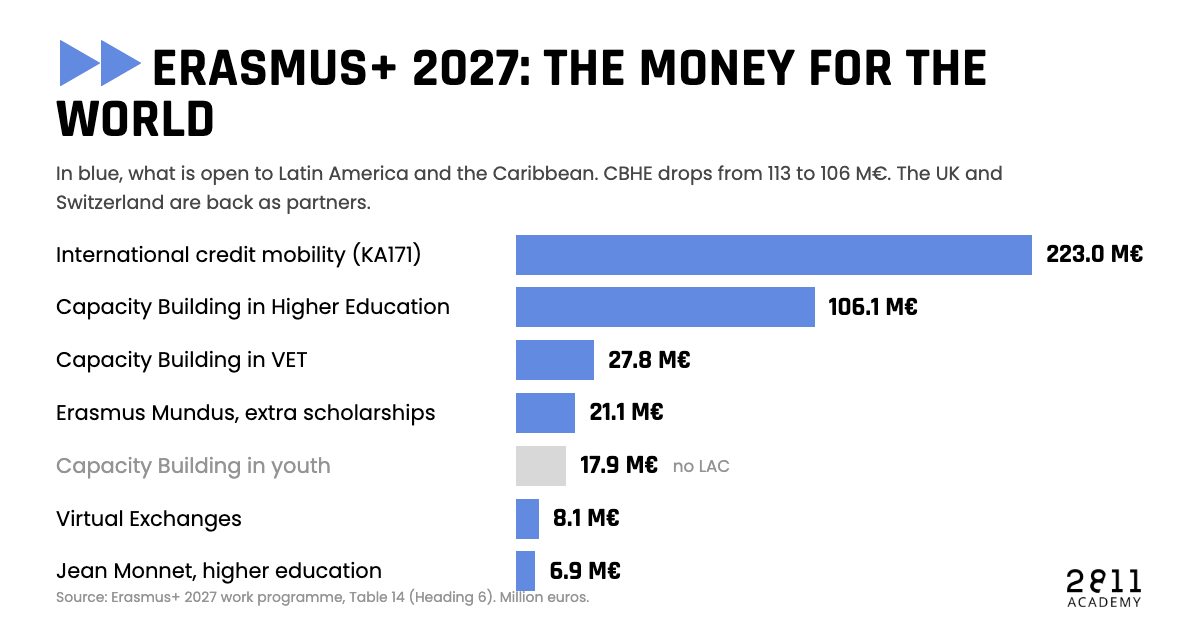
On 22 October 2026 the European Commission adopted the Erasmus+ annual work programme for 2027. It is the financing decision for the last year of the 2021-2027 programme, and it sets how much money each action will have before the Programme Guide and the calls come out. We read it from the point of view of a university in Latin America and the Caribbean. These are the changes that matter, and what we would do with them between now and February.
In short
- 2027 is the last call under the current rules. The 2028-2034 programme is still being negotiated, so the next call will come with new rules and new templates.
- Capacity Building in Higher Education (CBHE) has 106 million euros, about 6% less than the roughly 113 million of 2026.
- The United Kingdom and Switzerland are associated to Erasmus+ in 2027. Their universities can join consortia as full European partners again.
- Global Gateway is now the explicit frame. The work programme asks CBHE projects to make higher education systems relevant to the Global Gateway investment priorities, and it links Capacity Building in VET directly to the EU-Latin America and Caribbean Global Gateway Investment Agenda.
- The new money is moving to the Mediterranean. A Mediterranean University, a targeted initiative for Palestine, and a youth capacity building action whose eligible regions do not include Latin America.
1. The last call with rules we already know
Every Erasmus+ programme ends with a call that looks like the previous ones, and starts with one that looks like nothing before it. The Commission proposed the 2028-2034 programme in July 2025, merged with the European Solidarity Corps, and Parliament and Council are still negotiating it. The final regulation is not expected before the end of 2027.
For a university in the region this has a practical side. The 2027 call works with the templates, the evaluation criteria and the lump sum model that the European partners already know. The first call of the next programme will be a learning year for everybody. If an institution has a project in mind, 2027 is the year in which experience counts the most.
2. Less money for CBHE, and more competition
The 2027 work programme gives CBHE 106,050,000 euros: 96.3 million from NDICI-Global Europe and 9.8 million from the pre-accession instrument for the Western Balkans. In 2026 the action had about 113 million. A 6% cut, in the last year of the cycle, means the same number of consortia competing for fewer grants.
The three strands stay the same: access to cooperation (Strand 1), partnerships for transformation (Strand 2) and structural reform (Strand 3). The amounts per project will be confirmed in the 2027 Programme Guide. In 2026 they ranged from 200,000 euros in Strand 1 to one million in Strand 3.
One rule that is easy to overlook, and that the work programme keeps: the coordinator can be a higher education institution from a country not associated to the programme. A university in Chile, Colombia or Peru can lead a CBHE project, not only join one.
3. Two new European partners: the United Kingdom and Switzerland
This is the change that has had the least attention and may matter most to the region. The work programme lists Switzerland and the United Kingdom as third countries associated to Erasmus+ in 2027, subject to the conditions of their association agreements.
British universities since Brexit, and Swiss universities since 2014, could only take part in Erasmus+ projects in a limited way, without the status of a European partner. From 2027 they can be full European partners in a consortium. For Latin America and the Caribbean that opens two doors:
- CBHE consortia. Many universities in the region have long-standing ties with universities in the UK and Switzerland, in research, doctoral training or joint programmes, that could not become an Erasmus+ project. Now they can.
- International credit mobility (KA171). Mobility with countries outside Europe is applied for by the European university, through its national agency. The work programme allocates 23.5 million euros of the international mobility budget to the United Kingdom and 4.1 million to Switzerland. That is new money for exchanges with the region, held by institutions that have been outside the programme for years and are now looking for partners.
4. Global Gateway is now the frame
The work programme says that CBHE should “enhance the relevance of these countries’ higher education systems for the successful implementation of the Global Gateway strategy and its corresponding investment priorities”. The listed priorities are Global Gateway, the Green Deal (climate, environment, energy and alignment with the Paris Agreement), digital transformation, alliances for sustainable growth and jobs, migration partnerships, and governance, peace and security.
For Capacity Building in VET (27.75 million euros), the link is even more direct: the text names the Global Gateway priorities of Latin America and the Caribbean and refers to the EU-LAC Global Gateway Investment Agenda.
What this means when writing a proposal: a project that improves teaching in a faculty is no longer enough on its own. The evaluators will read relevance against what the EU is investing in the region, from the energy transition and critical raw materials to digital connectivity and health. The proposal that makes that link explicit, with data from the country, has an advantage.
5. Where else the priorities are moving
Reading the work programme as a whole, there is a clear direction. In 2027 CBHE includes support for a possible Mediterranean University under the Pact for the Mediterranean, adopted in October 2025, and a targeted initiative in Strand 2 to build an open digital education environment for students in Palestine. Capacity building in the field of youth (17.9 million euros) is limited to the Western Balkans, the Eastern and Southern Neighbourhood and Sub-Saharan Africa. Latin America and the Caribbean are not on that list.
None of this closes CBHE to the region, which remains an eligible region with its own budget envelope. But it does say that Latin America is not where the new money is going, and that a proposal from the region has to earn its place on the quality of the project.
6. The other doors
CBHE is the main action, but not the only one. These are the 2027 lines, funded from the EU external action budget, that involve universities in the region:
| Action | 2027 budget (EUR) | How the region takes part |
|---|---|---|
| Capacity Building in Higher Education | 106,050,000 | As partner or coordinator, in consortium with European institutions |
| Capacity Building in VET | 27,750,000 | Technical and vocational institutions, as partner or coordinator |
| International credit mobility (KA171) | 222,963,300 | Through a European partner university, which applies to its national agency |
| Erasmus Mundus, additional scholarships | 21,121,400 | Scholarships ring-fenced for students from the region in joint masters |
| Virtual Exchanges | 8,100,000 | As partner in online exchanges coordinated by a European institution |
| Jean Monnet (higher education) | 6,900,000 | Modules, chairs and centres on EU studies, open to institutions worldwide |
Source: Erasmus+ 2027 annual work programme, Table 14, breakdown of Heading 6 budget lines.
What we would do between now and February
The 2027 Programme Guide is expected in November, and based on the 2026 cycle, the CBHE call should close in early February 2027. That leaves about three months. With that time, the order matters:
- Define the problem before choosing the action. Set out what the institution intends to change and which strand corresponds to it.
- Close the consortium in November. Experienced European partners commit early, and this year two additional countries should be considered.
- Draft the proposal against the evaluation criteria, with the Global Gateway link made explicit. Relevance, quality of design, quality of the partnership and impact, each with evidence.
- Link the lump sum budget to the work packages from the outset.
- Complete PIC validation, legal documents and mandates during December, rather than in the final week before the deadline.
At 2811 we have been inside these calls as partner and as coordinator, in Students4Change and Climate Labs (CBHE), the LATAM-EU Sustainable Food Systems Academy (Capacity Building in VET) and Labs 4 Change. If your university wants to apply in 2027, we can write the full Erasmus+ proposal with your team: design, consortium, Part B, budget and submission.
Sources: European Commission, Erasmus+ annual work programme 2027, financing decision adopted 22 October 2026 (EU Publications Office), sections on Capacity Building (Heading 6), Erasmus Mundus, Virtual Exchanges and youth capacity building, and Tables 14 and 15 · Erasmus+ Programme Guide 2026 · EACEA, CBHE 2026 call. Amounts per project and deadlines will be confirmed in the 2027 Programme Guide.